

Case Studies in Self-Help Books
Why they matter and how to write them

Most good self-help books include case studies.
But “case study” sounds scary. What I’m really talking about is stories and practical examples.
This is where you show your reader how what you’re teaching actually works and plays out.
And it’s crucial for most self-help books
Why You Need Case Studies
A case study provides a “real life” (more on that in a minute) example of how your lessons, tips, and processes actually work.
They can be used to illustrate the problem that needs solving, and then to give the reader an easy-to-follow walkthrough of how to solve it.
Case studies bring your book to life and make it practical and applicable, while allowing the reader to easily envision what you’re teaching. The stories allow them to see things play out in real scenarios and “see” themselves using your advice and strategies. It makes it all feel more down to earth and approachable.
Stories allow the reader to see “proof” of your advice working, which sways them to keep reading and may influence their review and opinion of your book.
They also serve as a kind of proof that what you’re teaching actually works.
There is a visual benefit to these stories as well. They break up the text and give you a reason to use boxes, creating some visual interest. They also let the reader take a breath and process the things you’ve been teaching.
If you’re not using AI, you’re falling behind. Hiding your head in the sand isn’t going to make it go away. Learn how to leverage this tool for your own benefit, without giving it access to your own unique work in my online class, Use AI as Your Book Proposal Coach
Do They Have to Be Real?
Most of my authors assume that the case studies have to be real, but they don’t.
If you have actual client stories that illustrate your points, that’s terrific. But if you don’t, it’s fine to make up examples. Don’t say they are real, but don’t come out and say they are made up either. Just tell the story and let the reader draw their own conclusion.
It’s also okay to take pieces from real clients and adjust the stories to fit your points.
Using Yourself as a Case Study
It can be very effective to tell your own story as examples for the things you are teaching. It makes the book feel very personal and intimate. This allows you to share feelings and thoughts that can increase the emotional resonance of the book.
You don’t have to use your own story, though, and many authors choose not to. Or you can tell some of your own experiences, in addition to your other case studies.
How Often to Use Case Studies
I like to see some consistency in their placement. If you’re going to use them, there should be at least one in each chapter. I wouldn’t use more than one every five or six pages, though.
Can My Case Studies Stand Alone?
Some authors use case studies to teach concepts, processes, or ideas and don’t reiterate or explain those things in the regular text.
I prefer to do both - use your story to illustrate your point, but also use your text to give clear instructions and information that readers don’t have to try to glean from your examples.
How Long Should a Case Study Be?
A general rule of thumb is you want it to be at least one meaty paragraph. Anything shorter than that can be told within the text of the chapter as a short example.
One page is a good limit to try to stick to if you can. There are definitely situations in which they can be longer, but those are rare.
What to Call Them?
Some authors like to come up with catchy titles for these stories. I worked on a restaurant management book, where we called the case studies “Mise en Place” (restaurant-speak for getting all your ingredients ready before you cook).
You can simply title them Case Study if you want of course.
It is useful to have a subtitle for each so that they can be distinguished (like Case Study: Tomaso’s Story).
In My World
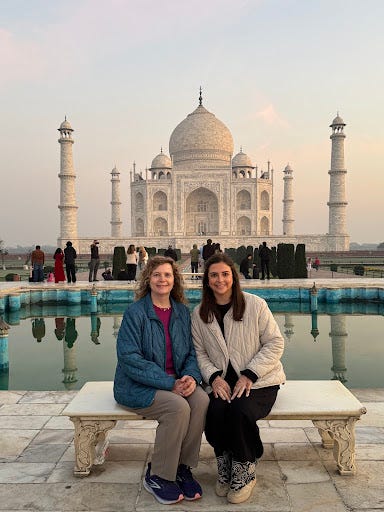
I traveled to India to go to a wedding as my daughter’s plus one and had an amazing time. We saw so much and did so much. India is beautiful and overwhelming.
Getting out of my normal life and experiencing other cultures and ideas always jumpstarts my creativity, so I’m working on a new book inspired by the journey. I am, however, struggling with jet lag, which means I’m crashing each night by 8 and am waking up much too early.
I’ve got some new client projects I am staying busy with, including several memoirs and a leadership book, as well as a very unique grief book.
Obsessed With…
The best thing I read while I was away is The Correspondent by Virginia Evans. I am a sucker for a good epistolary novel. This one does not disappoint, though it is a little slow to get started. I highly recommend it and don’t want to give anything away about it so I won’t summarize, just tell you to go read it.
The first epistolary novel I read was 84 Charing Cross Road by Helene Hanff. Our 11th grade English teacher taught it. It was out of print at the time, and she ruthlessly violated copyright laws by photocopying and distributing it. I also read A Woman of Independent Means by Elizabeth Forsyth Hailey around that time. At that point I was hooked on this type of novel and am always on the hunt for more in this genre.
I watched some of the new season of Landman, the first episodes of the newest Bridgerton (both were so so good), and then became hooked on truly bad reality tv: Suddenly Amish on Max. It was like a car crash - I couldn’t look away. And I’m not sorry.
Good Goods
I am so happy to be home to my own pets, my own bed, my own house, and my own bathroom products. I missed my shower gel, Naturium The Glow Getter Multi-Oil Hydrating Body Wash, which is an oil that lathers. I haven’t needed much body lotion this winter because I’m using this. I was so happy to get back in the shower with it. It’s the little things.
Note: Some of the links may provide me with a small referral fee.
Hey Brette, the Taj. Beautiful. A true monument of love. I too want to go. Many years studying Hindi can finally be put to practice. Thank you.